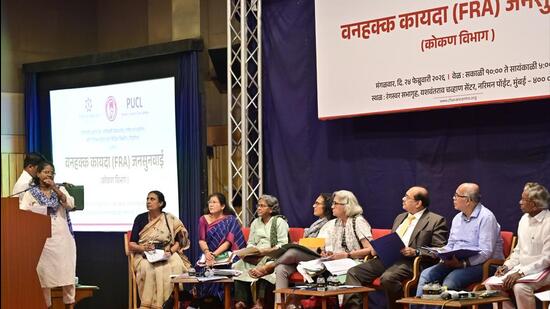
MUMBAI: Adivasis from the Konkan region on Tuesday shared their bleak experiences of claims under the Forest Rights Act (FRA), 2006, at a public hearing organised by the People’s Union of Civil Liberties (PUCL) at the YB Chavan Centre. The Act grants individual ownership rights and community forest rights to tribals.
Mumbai, India – Feb. 24, 2026: Adivasis from Konkan shared their experiences of claims with the Forest Rights Act, 2006, at a public hearing organised by the People’s Union of Civil Liberties (PUCL) at the YB Chavan Centre on Tuesday. A panel including retired justice Abhay Thipsay, ex-bureaucrat Lakshmikant Deshmukh, ex-minister Vasant Purke will compile an audit report on two decades of implementation of the FRA to be submitted to the state government in Mumbai, India, on Tuesday, February 24, 2026. (Photo by Anshuman Poyrekar/Hindustan Times) (Anshuman Poyrekar/HT Photo)
A panel comprising retired high court judge Abhay Thipsay, ex-bureaucrat Lakshmikant Deshmukh and ex-tribal minister Vasant Purke will compile an audit report on two decades of implementation of the FRA to be submitted to the state government.
About 40 Adivasis from padas in various parts of the Konkan region spoke on their experiences over two decades of implementation of the Act. The public hearing, jointly hosted by the Shoshit Jan Andolan and the Centre of Tribal Development of the Y B Chavan Centre was held to audit the implementation of the landmark Act.
Most tribals at the public hearing narrated grim tales of how their ancestral lands were taken away for dams, forests and even golf courses and how they were even denied compensation or even rights. Susheela Bhoi from Karjat recounted how her fruit-laden farms were set on fire about a decade ago by forest officials. A couple from Kharghar described how their rice fields were flattened with JCBs and given away for a golf course over which they themselves were denied even pathway access to their villages.
Purke attributed the deliberate denial of tribal rights to the lucrative land costs in the Mumbai Metropolitan Region eyed by the powers that be. Adivasis from Mumbai narrated how they felt shortchanged, as the government refused to even accept their applications to claim individual ownership and community rights.
Shakuntala Dalvi, a resident of Palaspada, close to the Mulund side of the Sanjay Gandhi National Park (SGNP), recounted how her community members were always shunted from ward to ward by the BMC when they went to submit their applications under the FRA.
“Six villages at Saibangoda were disturbed to make way for Vihar Lake,” she said. “Although indigenous tribes lived here even before the dam came up and supplied water to the whole of Mumbai and its ministers, the original residents were berated for staying around it and asked to shift out.” Dalvi also mentioned how despite two surveys done on the Adivasi community in Mumbai, one in 2003 and the other in 2025, which included the tribals staying in the 56 padas in SGNP, 27 padas in Aarey, six padas in Gorai and 10 padas in Mudh village, the reports were never made public.
Activists found that in Maharashtra, though the titles of more than 1,99,000 individual claims had been distributed, 49.09% of all individual forest rights claims were rejected. Additionally, more than 28,000 claims continue to be kept pending.
Lara Jesani, national secretary of PUCL, said that the sharp rise in land prices in cities like Mumbai had led to extensive deforestation to make way for housing complexes, and thus there was a lack of political will in implementing the FRA.
Brian Lobo of the Kashtakari Sanghtana, Palghar, said that the public hearing was an attempt to exert civil society pressure on the government to act and ensure justice for the tribal community. Justice Abhay Thipsay said that although the FRA law was good, it was not executed on account of the implementing officials having no faith in it. He urged for sensitisation of the government machinery.
Lakshmikant Deshmukh urged the tribal community to stay alert and put up a united and strong fight in the wake of forest land being diverted for various projects like highways, dams and industrial parks and strong commercial forces eyeing their land.