MUMBAI: In IC Colony, Borivali west, a family cradles their 92-year-old father, picking their way through rubble and waist-deep trenches to reach an ambulance. Every second counts.
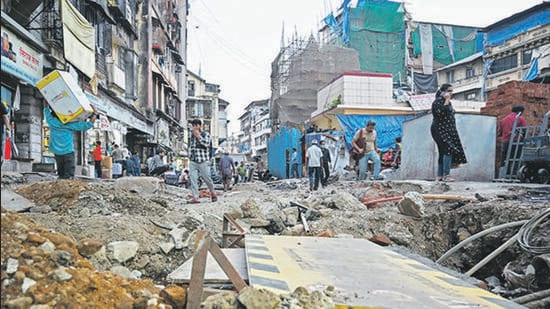
Across the city, at Sandhurst Road, a trader forfeits four business hours daily, opening only at noon after a sleepless night. The losses keep piling up.
Nearly four years after Mumbaiites were promised a pothole-free Mumbai, citizens are still paying a bitter price. The road concretisation drive, launched with much fanfare by deputy chief minister Eknath Shinde, has breached two deadlines already. The latest is end-2026 or early 2027.
But it’s not the faltering timeline that has Mumbaiites seething, nor is it the extent of the work. With 62.5% of the mega-project complete, the momentum has slowed compared to phase one, which covered large swathes of Mumbai in one go.
The real issue, residents argue, is the civic body’s unwillingness to discipline errant contractors. With little oversight, the haphazard execution of contracts is upending life in several neighbourhoods, just as it did in a tumultuous phase one.
From Sion to Borivali, Sandhurst Road to Mulund and Bandra, citizens told Hindustan Times that roads are either completely dug up, partially concretised, or only partially excavated, with work halted for weeks and even months.
They say they have no access to fire and ambulance services; are prone to tripping and falling on uneven surfaces; reeling under dust and noise pollution; and heaving under disrupted sleep as work cycles.
Brazen contractors
HT accessed a traffic police no-objection certificate (NOC) issued for road concretisation work. The NOC lists 22 conditions, including a stipulation that both sides of a road cannot be excavated simultaneously, and at least one lane must be kept open for vehicles. It warns that violations would lead to cancellation of the NOC and filing of criminal charges against the contractor.
The fine print is formidable but, for contractors, it’s little more than ink on a page, observed more in the breach than in practice. “Despite the traffic NOC listing several conditions, the BMC doesn’t seem to notice these violations,” says activist Kamlakar Shenoy.
Efforts to reach joint commissioner of police (traffic) Anil Kumbhare were unsuccessful, but a senior BMC official said contractors were faced with several “limitations”. “In some locations, we have to excavate the entire road to allow the RMC trucks and dumpers to come in. If we dig only half the stretch, it would leave no room to work or walk,” the official said.
Asked why deadlines are routinely breached, he cited “unforeseen issues”, a stock response that has come to mask chronic delays. “We are not in a position to resolve every difficulty immediately, but we are doing our best with the interest of citizens in mind. Residents can reach out to us whenever required,” said the civic official.
Girish Nikam, chief engineer, roads and traffic with the BMC, said in some places, work halts due to work on utilities that requires coordination. “The coordination is being carried out and we are hopeful of completing it at the earliest,” he said.
Citizens are not buying the official line. They ask how the country’s wealthiest municipal corporation, with enormous financial and administrative muscle, can still fail to deliver on time. Here’s why they are crying foul.
Borivali: Alarm Bells
At Cross Road No 3 in IC Colony, Borivali west, an excavated road extending half a kilometre, turned into a nightmare for one family hit by a medical emergency.
A resident had to move her ailing 92-year-old father to an ambulance but the road did not allow vehicles access. “We had to carry him in our arms. In an emergency, your only thought should be how quickly you can reach a hospital. But that night, our bigger worry was how to navigate such a long, broken stretch while holding him. No one should have to go through this,” said the resident
Cross Road No 3 has been in limbo for more than three months, impacting around 25 buildings.
Another resident, Vijay Lade, 75, said, “We are not against development, but the prolonged work has made daily life very difficult. Walking is unsafe, vehicle movement is restricted, and emergency access is a concern.”
Sandhya Nandedkar, assistant municipal commissioner of R/Central ward, did not respond to HT’s phone calls and messages. Rekha Yadav, the local corporator, said delays were linked to pending permissions and utility work, including water pipeline connections and cross-section testing. “All our permissions have been granted and work will start soon,” she said.
Sion: Health Risk
In Bhandarwada, Sion east, a 200-metre stretch remains excavated for the last four months, impacting more than seven buildings. Residents say the garbage truck cannot make its way in, forcing them to dump their trash at one extreme end until it is picked up. The foul odour is unbearable.
Streetlights were removed when the road was first dug up and the area remains in darkness. “Work began four months ago and is far from complete,” said Karuna Mhatre, 60, a resident.
Residents are also upset at the racket made by RMC trucks at night, sometimes until 2am.
Local corporator Rajeshree Shirwadkar said residents had asked civic engineers to undertake concreting during the day. “That is why work has stopped. We are following up with the engineers,” she said.
A senior BMC official from F/North ward confirmed that work would resume soon. “We are in talks with citizens and the corporator,” he said.
Sandhurst Road: Isolated From All
On Nowroji Hill Road No 5, just outside Sandhurst Road railway station, the road extends 200 metres – excavation began three months ago and the surface is yet to be levelled and concretised.
A resident of Tej Kiran building said electricity lines were damaged, leading to a two-day outage. Santosh Sarole, 53, another resident, said late-night work till 4am is casing sleepless nights. “We get sleep only after the work halts, in the early hours. As a result, I end up getting to my metal workshop at 1pm instead of the usual 8.30am.”
“This is not a very long stretch but we feel cut off. All our complaints have fallen on deaf ears. Even just walking on the road is hazardous,” says Arun Chauhan, 40, a businessman and resident.
Kamalakar Shenoy, an activist from B ward, claims roads at 12 locations in the ward have been excavated on both sides.
A senior civic official said stoppages can occur due to substandard work by contractors, political intervention or unforeseen utility issues. “The delay is not always in our hands,” he said.
Masjid Bunder: Only the Beginning
A 100-metre stretch at Bhat Bazar in Masjid Bunder, lined with around 10 shops and eight residential buildings, is caught in a crisis of sorts ever since road work began a fortnight ago.
Two-wheelers were removed overnight. “When we woke up the next morning, the contractor had shifted our vehicles and they were towed by the RTO,” says Ravi Thorve, 50.
While residents claim at least half a dozen people have tripped and fallen since the work began, shopkeepers said footfalls have dropped nearly 30% and businesses along the stretch reported mounting losses.
PL Tambe, 55, manager of Hotel Apex Regency, which usually houses patients and their families visiting Saifee Hospital, has been directly hit. “More than five customers reached out to us, but when they saw there was no motorable road, they backed out.”
Water connections are frequently severed by excavators. “I have already spent more than ₹6,000 on water tankers,” Tambe said.