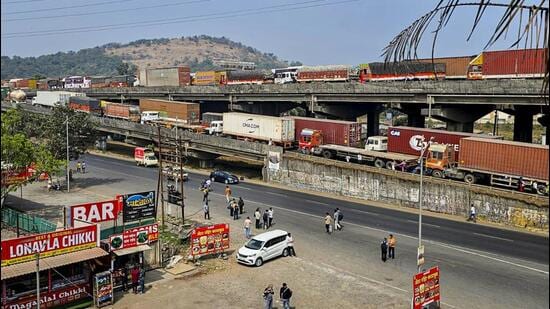
What began as a safety shutdown after a hazardous gas tanker overturned near the Adoshi Tunnel turned into a human ordeal for thousands of commuters, with families, elderly passengers, children, and professionals stranded for up to 15 hours on the Mumbai–Pune corridor without access to toilets, drinking water, or food, as traffic crawled or remained at a standstill for most of Tuesday night and Wednesday.
For many, the gridlock was not just about delay but dignity and distress.
Near Khalapur Toll Plaza, Pune resident Rohit More was stranded overnight with his two children, aged one and three. “There are no toilets, no place to even step out safely. Managing infants inside a parked car for hours is exhausting,” he said. “Milk ran out, diapers became an issue, and the children were crying through the night. This was not something we could have prepared for.”
Several commuters said they were forced to ration water, skip meals, and sit inside vehicles for hours without ventilation as temperatures fluctuated. Parents struggled to calm restless children, while elderly passengers complained of body pain, dehydration, and anxiety.
Sanjay Mundada, a project management professional heading to Mumbai for an important meeting, said the jam made even remote work impossible. “I tried attending my meeting from the car, but network issues and noise made it futile. After eight hours, I had no option but to inform my office that I wouldn’t make it. An entire workday was lost,” he said.
Others simply gave up.
At multiple points along the expressway, commuters said vehicles were turning back or exiting midway, abandoning critical appointments. “I was travelling to Mumbai for a court-related matter,” said Rakesh Kulkarni, a commuter from Pimpri-Chinchwad. “After nearly six hours without any movement and no facilities, I decided to return. Missing the hearing was unavoidable, but staying stuck without water was worse.”
Elderly passengers were among the worst affected. Vilas and Shalini Minjare, travelling from Nashik to Mumbai for a medical appointment, were diverted via Tamhini Ghat after being stuck for hours. “At our age, sitting continuously in traffic without toilets is extremely uncomfortable,” Shalini said. “We understand safety concerns, but there should be some emergency arrangements for people.”
College student groups and families travelling for short trips said they cancelled plans altogether after seeing the scale of congestion. “We spoke to drivers who had been stuck since evening,” said Anita Patel, who turned back from Urse Toll Naka. “Once we heard it involved a gas leak inside a tunnel, we decided it wasn’t worth the risk.”
The crisis was triggered on Tuesday evening when a tanker carrying highly flammable propylene gas overturned at the mouth of the Adoshi Tunnel in the Borghat section of the Mumbai–Pune Expressway. Gas leakage raised fears of an explosion, forcing authorities to completely shut the Mumbai-bound carriageway as a precaution.
Emergency teams from the Highway Police, fire brigade, IRB, local rescue units, hazardous-material specialists, and NDRF were deployed. Officials said the tanker could not be moved until the leakage was fully controlled, as even a minor spark could lead to a major incident.
Highway Police Superintendent Tanaji Chikhale said traffic congestion stretched up to Khalapur Toll Plaza on the Pune-bound side and nearly 10–12 km toward Pune. “The intensity of the gas leakage has increased. The Mumbai-bound lane has been completely closed as a safety measure. Motorists will have to face delays until the situation is fully under control,” he said, advising commuters to use alternate routes via Tamhini Ghat and Karjat.
However, commuters said diversions offered little relief, with secondary routes also choked and lacking basic amenities. They were unhappy that despite high amount being charged as toll, authorities failed to offer any respite.
As containment operations continued, the incident exposed a deeper gap in highway disaster management — the absence of emergency facilities for stranded motorists. For those trapped through the night, the experience was not just about traffic, but about being left to cope without the most basic necessities on one of the state’s busiest transport lifelines.