Mumbai: After a delay of five months, the boring of the second tunnel of the ambitious Mumbai coastal road project was finally completed on Tuesday. The “breakthrough” at Priyadarshini Park was heralded with a pooja and much fanfare in the presence of CM Eknath Shinde.
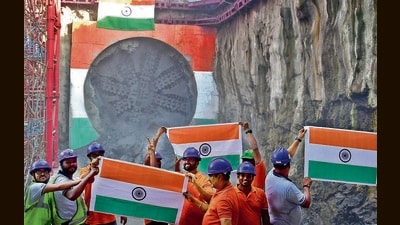
Work on the second tunnel from Girgaon Chowpatty to Priyadarshani Park had started on April 26 last year but was halted for three months after a part of the tunnel boring machine got damaged. The work resumed by March end this year when the new spare part arrived from Italy. However, the BMC tread cautiously with the work and took two months to complete the second tunnel boring.
Vipul Surana, team leader of AECOM, the general consultant appointed for the coastal road project, explained the engineering term “breakthrough”. “It is a term for when a tunnel is open from both sides,” he said. “We have achieved that. Our deadline is the end of the year and we have finished the critical part in time.”
Talking of challenges faced during the tunnelling, Surana said that tunnel-boring under the sea was a challenge. “If there was a system error, we had to get the right engineer to repair the machine on time,” he said. “Tunnelling under the sea and under Malabar Hill were unique challenges.”
The Mumbai coastal road tunnels are equipped with the Saccardo Ventilation System, developed for the first time in India, to provide a longitudinal air flow inside the tunnels. Surana said that the system would be installed after the mechanical and electrical engineering was done. “Work on the utility box below the tunnel will soon commence, followed by wiring and cabling so that the tunnel becomes functional in terms of emergency services,” he said. “After that the Saccardo system will be put in place.”
Surana said that the ventilation equipment was housed in technical buildings near Priyadarshini Park for south-bound traffic and near Girgaon Chowpatty for north-bound traffic. “This system has Saccardo nozzles which inject high-velocity jet streams into the tunnels during normal as well as emergency situations to remove pollutants or smoke,” he said. “The fans are reversible to cater to ventilation requirements during maintenance or emergencies. They will not be affected in the event of a fire. Also, the Saccardo system is highly efficient and with lower maintenance costs as compared to jet fan systems. The life of the fans and associated control equipment is over 50 years.”
CM Shinde at the event declared that Dahisar-Mira-Bhayander connectivity would be carried out in the next phase of the coastal road project. “A total length of 32 km of sea coast route will be available to Mumbaikars,” he said. “There will also be rapid movement from Mumbai to Raigad along the Western Express Highway. Mumbai’s traffic congestion will ease.”
Deputy CM Devendra Fadnavis, Guardian minister (city) Deepak Kesarkar, municipal chief Iqbal Singh Chahal, additional municipal commissioner (coastal road) Ashwini Bhide and D ward assistant commissioner Sharad Ughade were also present to experience the breakthrough moment on Tuesday.